Total Pageviews

Showing posts with label New Year's Eve; parties; fireworks; celebrations. Show all posts

Sunday, February 26, 2012

GREEK CARNIVAL: Apokries - A Hint of Ancient Dionysian Revels

GREEK CARNIVAL


If you’re sightseeing in the middle of Athens in February and you’re suddenly descended upon by a roving gang of young men wielding plastic bats, don’t be alarmed. They hit people over the head, but the head-bonking is part of the playful merriment that is apokries – carnival

Since ancient times, the Greeks have celebrated carnival with pre-Christian rites. Carnival comes from the Latin “Carne Vale” (farewell, flesh) and is the feast before the fast – triodio, three weeks of revelry preceding Lent. It is the Greek version of Mardi Gras.

You can detect a hint of the ancient Dionysian festivals in the celebrations. Groups of professional mummers used to roam the streets of Athens performing dances and pantomimes. Now, costumed revellers prowl the cobbled streets of the old Plaka district, bopping each other with the plastic hammers. Tangles of coloured streamers and confetti are tossed with abandon. There are private parties and celebrations at some of the hotels. Shop windows display extravagant costumes and masks.

In rural areas, plays and satires are performed, including the Funeral of the Miser, whose soul is taken by devils. In the Peloponnese region, a masked effigy of the King of the Carnival is carried on a bier and then set on fire. In ancient days the mock king was actually put to death. These rites are all symbolic, some dating back to Agamemnon’s time. One ritual is a mock wedding in which the groom is murdered and then resurrected, followed by a symbolic pantomime of plowing and sowing – nature’s renewal and the return of spring. These are similar to the rites of Dionysus, the ancient god of revelry and resurrection.

Even with the pagan holdovers, the religious meaning of this period is strictly observed. The first week, called profoni, is the time in which the fattened pigs are slaughtered and prepared for the feasts of the second “meat-eating week.” During profoni, it is believed the souls of the dead are set free and wander among the living.

On each of the three Saturdays of apokries, prayers are said and the koliva, a dish made of wheat, is prepared and consecrated, then distributed among friends and neighbours in memory of deceased relatives. On the second Thursday of apokries, the pork feast begins and so does the masquerading. In the third week, only dairy foods and eggs may be eaten, in preparation for the long Lenten fast.
My friends and I celebrate Apokries at Patras. (I'm in a butterfly costume!)

Tirokiriaki (Cheese Sunday) is the most vibrant day of the celebrations and includes dancing, masquerades, parades and play-acting. The most spectacular parad is held in the Peloponnese at Patras. Busloads of carnival merry-makers arrive from Athens and the surrounding villages, flooding into the streets of the small port city, swinging their plastic bats, tossing rainbow coils of paper streamers and confetti and squirting one another with coloured plastic foam from aerosol cans.

Carnival is particularly appealing to children and each weekend of apokries the Zappeion and National Gardens in Athens are filled with youngster, masquerading clowns, fairies, musketeers, demons and fantasy creatures. Adult merriment begins at night. Take along your bat.
Children in the National Gardens, Athens

Note: This story was first published in the Globe and Mail, February 5, 1986.

Friday, May 20, 2011

VICTORIA'S HISTORIC BUTCHART GARDENS


As part of our Royal Wedding weekend, my friend and I went to historic Victoria B.C. to celebrate. One of the special things we did on our last day there was to visit the famous Butchart Gardens.
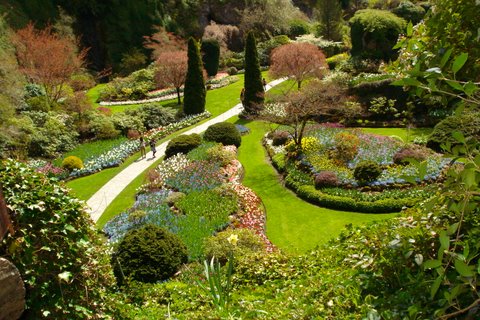
Victoria B.C.'s historic Butchart Gardens is one of the most popular floral show gardens on the West Coast. This magnificent landscaped area which covers 22 ha(55 acres) was conceived in 1904 and designed by Jennie Butchart after the limestone quarry that her husband Robert Pim Butchart had acquired for his burgeoning cement business was exhausted.  Under Jennie's supervision and artist eye, the abandoned quarry blossomed into a spectacular Sunken Garden.

The gardens grew into a beautiful early 20th century showpiece in the style of the grand estates of the period.  Besides grassy lawns, flower beds, ornamental trees and a unique collection of memorabilia brought by the Butcharts from their travels,  there are nurseries for plants, trees and shrubs.
Among the objects collected from their travels is the Fountain of the Three Sturgeons and the life-like bronze casting of a wild boar, both from Florence, Italy.
Fountain of the Three Sturgeons
The Butcharts also created a beautiful Italian garden beside their house.

The Italian garden
 By the 1920's more than fifty thousand people were coming each year to visit the Butchart's Gardens and today they are one of the most popular tourist destination for visitors to Vancouver Island and Victoria.


The Butchart's luxurious house which included a bowling alley, indoor salt-water swimming pool, billiard room and a self-playing Aeolianpipe organ, is now the Dining Room Restaurant and offices with some rooms still used for family entertaining.  The Garden is still operated by the family.  The Rose Carousel, the only carousel on Vancouver Island, is a fun diversion for youngsters and adults alike. The carousel is a menagerie of animals, birds and decorative mirrors. The designs were hand picked by the great grand daughter of Jennie Butchart and the carvings were done by some of the few remaining carvers of carousel art.  It's housed in the Children's Pavilion under a clear dome and a roof planted with native plant species.


A popular part of Butchart's is the Japanese garden area where you can walk quietly under the trees over small ornate bridges and cross the creeks on stepping stones. 

Everywhere you look,  the gardens are full of glorious blooms.  On this visit it was a brilliant array of tulips and blossoming trees.  It's easy to see how Butchart's Gardens has an international reputation for it's year round displays of flowering plants. 


This visit to Butchart's Gardens was a perfect way for my friend and I to end our special visit to Victoria to celebrate the Royal Wedding weekend.


Add to Technorati Favorites

Thursday, December 27, 2007

ONCE UPON A NEW YEAR'S EVE


"A guid New Year to ane an' a' and mony may ye see."
Traditional Scottish New Year's toast.

ONCE UPON A NEW YEAR’S EVE

December 31, the final day of the Gregorian year and the day before New Year’s Day, is also called Hogmanay (in Scotland) and Sylvester (in Germany, Israel, Hungary and Poland.) In the 21st century western practice, New Year’s Eve is traditionally celebrated with parties and social gatherings. Many countries use fireworks and other forms of noise making to welcome in the new year. Some countries have odd traditions associated with this eve.

In Brazil music shows are held, most famously at the Copacabana Beach in Rio de Janeiro and in Sao Paulo they hold the Saint Sylvester Marathon, contested by athletes from all over the world. The Danes celebrate with family gatherings and feasts. In Ecuador they have elaborate effigies called Anos Viejos (Old Years) created to represent people and events from the past year. These are often stuffed with firecrackers. One popular tradition is the wearing of yellow panties, said to attract positive energy for the new year.

The French celebrate with a feast called Le Reveillon de la Saint-Sylvestre. In Berliin Germany, a huge display of fireworks is ignited at the Brandenburg Gate. There’s also fireworks in Hong Kong and in Japan the Buddhist temple bells are rung 108 times. Mexicans down a grape for each of the 12 chimes of the church bells and people who want to find love in the New Year wear red underwear (yellow for money)

Auckland, New Zealand is the first major city to see the beginning of the new year as it’s 496.3 kilometres west of the International Date Line. The Filipinos celebrate with a dinner party called Media Noches. They have a custom of wearing clothes with a circular pattern, like polka dots, to attract money and fortune.

In Spain families celebrate with a special dinner of shrimp, lamb or turkey and also wear red underwear for luck, and eat the 12 grapes synonymous with the new year. In Turkey homes are lit up and decorated with garlands and public celebrations are held. In Greece, while the adults gamble at card games, the children go around ringing little triangles while they sing kalendalas (carols) as this is the night that Agio Vassilis (St Basil) comes with gifts for them.

In the U.K. Big Ben strikes the midnight hour as the crowds count down the chimes to the hour. In London the London Eye is the centre of a 10 minute fireworks display illuminated with coloured lasers. In Scotland, the traditional son Auld Lang Syne by Robert Burns, is sung and street parties are held. In the States the Bell Drop at Times Square in New York is broadcast through America and Canada.

I have both fond and melancholy memories of New Year’s Eves. In the old times it was one of the most anticipated holidays next to Christmas. You always had a new outfit to wear which was planned well in advance, something fashionable and spectacular to wear to the celebration which was often held in a night club or at a gala house party. I’ll never forget the year I’d made a gorgeous gold pois de sois two-piece dress. I looked fantastic. But when I arrived at the big party with several other couples, I was chagrined to find that another woman in the group was wearing a dress of similar style and material. I was crushed, but of course I had made mine myself so considered it to be more ‘original’.

I recall one New Year’s Eve when I was in my late teens, my girlfriend and I had been invited out by two American sailors to attend a show at a supper club. My girlfriend had a new dress but hadn’t time to hem it so she’d pinned the hem up with straight pins and all night long the pines scraped her legs until they were bleeding. After the show at the nightclub, we tottered over to the Catholic cathedral for midnight mass. I was in charge of holding the bottle of wine in a brown paper bag under my coat and I distinctly recall dropping it in the back pew!

Yes, New Year’s Eve was always a night of wild abandon and over-drinking. At clubs or house parties, when it turned midnight, traditionally you are supposed to kiss your partner or date under the mistletoe or wherever you happen to be, but all too often I’d find myself alone in a crowd of strangers while my significant other was off in a corner kissing someone else. I soon grew weary of these episodes. new Years eve began to lose it’s romantic appeal, and instead it became a lonely time, especially once I was single. Eventually, I decided I’d rather stay home alone, so I’d bring in some goodies: the makings for Welsh rarebit, oysters to fry, a few bottles of McEwan’s ale and a bottle of Heinken Trokel wine. I’d mention to a few close friends that I was staying home that night, and wait to see who’d show up. Usually a couple of friends would drop by to share the celebration with me. But one of my most memorable New Year’s Eves was one I spent all alone enjoying my own company, dancing to my favourite music.

I’ve had New Year’s Eves abroad, far from family and close friends, and these turned out to be fun in their uniqueness. I recall my first New Year’s Eve in Greece (which turned into one of my most memorable). My room-mate and I decided to go to the fabulous Intercontinental Hotel piano bar to spend the evening. On the way, we stopped by a pizzeria to have a bite to eat. I made a spectacular entrance by almost walking through the glass door which I didn’t realize was closed, and I got a standing ovation from a troop of merry Quantas Airlines flight attendants who were partying there. We ended up joining then for one of the craziest, most fun New Year’s Eves ever. And I even won the New Year’s prize -- a nice boyfriend who was around as long as Quantas flew into Athens every two or three weeks.

Nowadays on New Years, I will make plans to go out if friends are going along and the price is right. Being with close friends, dancing and dining, is quite a satisfying way to end the old year. Although it’s no longer the ‘romantic’ exciting night it used to be, it’s worth a little celebrating. This year I’ll go with my girlfriends to enjoy an evening of the Blues at the bistro where my son plays. I wonder if I should wear the red or the yellow undies?

HAPPY NEW YEAR TO ALL MY FRIENDS AND FELLOW TRAVELERS!


Posted by Picasa