Total Pageviews

Sunday, May 25, 2014

LUXOR TO THE RED SEA: A DESERT EXCURSION


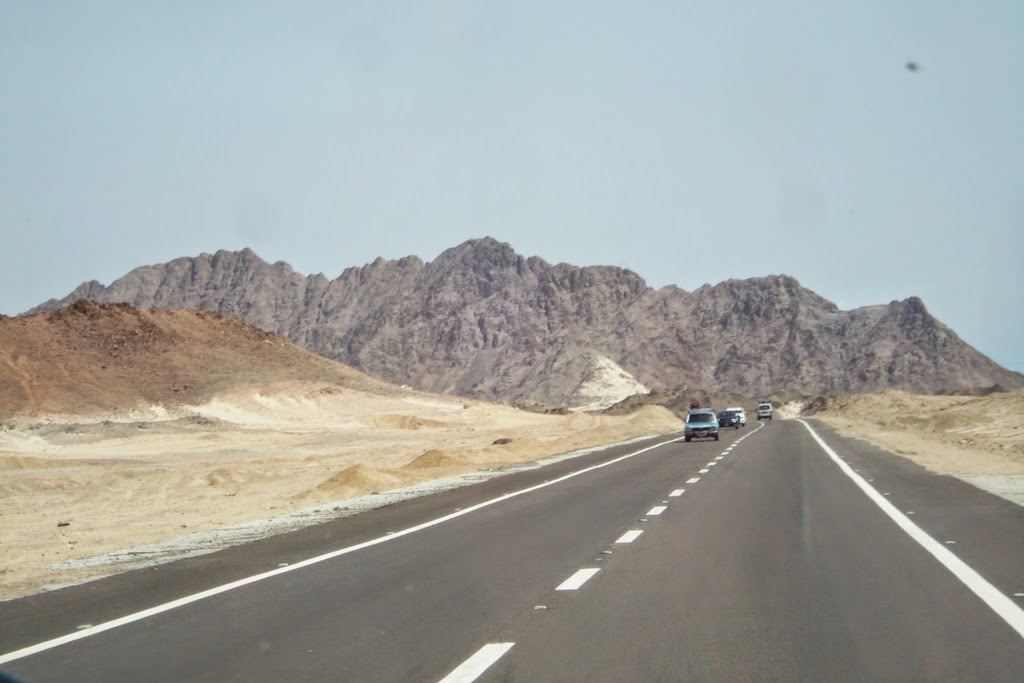
I’ve always been curious about the desert so when I learned we would drive from Luxor to Soma Bay on the Red Sea, a distance of about 327 kilometers, I was excited at the opportunity to experience the Sahara first-hand. I’d seen the desert in movies but this would be the real thing.


The Sahara is the world’s hottest desert, over 9,4000,000 square kilometers. It covers most of North Africa, stretching from the Red Sea, including some of the Mediterranean cost, to the Atlantic Ocean. The name comes from the Arabic word for desert “sahara” .


We set off in the morning from Luxor, boarding a van provided by Escapade Travel Transportation. Once we had driven through the town of Luxor we headed out into the vast expanse of sandy dunes.  The only greenery is near the Nile River Valley  so for most of the trip all we’d see was the vast stretch of dunes with occasional palm trees, shrubs or acacia trees.  Farther ahead were rocky crags and then more stretches of dunes.


Ever so many kilometers on the straight stretch of highway there was a check point where armed guards looked over the vehicle. On at least one occasion I saw sniffer dogs.  This was in no way disconcerting as it was similar to passing through border crossings.

The Sahara has one of the harshest climates in the world. Sand storms are common and the north-easterly wind is strong. Rainfall is rare, with the area receiving less than four inches or even less, a year. It’s interesting to note that thousands of years ago the Sahara was much more verdant. Evidence has been found of whale fossils and dinosaurs. Now the only areas with lots of vegetation are the Nile River Valley and some of the oases near the Mediterranean Sea. As for animals on the desert, we occasionally saw camels or goats which are the most domesticated animals in the desert.  These were mostly seen near places where there were oases or habitation.

As we neared the coast, the land was flat, stretching out like a buff-colored blanket. The highway was clear of traffic so we made good time reaching the coast, then turned south toward Soma Bay. Finally, I got my first glimpse of the Red Sea. And guess what?  It was turquoise!

NEXT:  Have I died and gone to Shangri-La?

THE KEMPINSKI SOMA BAY HOTEL RESORT


Sunday, May 18, 2014

THE MAJESTIC TEMPLES OF LUXOR AND KARNAK


Sphinx Avenue


The city of Luxor is a pleasant city beside the Nile River, with a population of ½ million people. Right in the centre of Luxor (known as THEBES in ancient times), there is a magnificent temple built by Amenophis III (1417-1370 BC) and Rameses II (1104-1237 BC).  It is dedicated to the Theban Triad (Amun-Min, Mut and Khonsu). This is one of the most historic temples of ancient Egypt. The Egyptians called their temples ‘the houses of eternity’. Perhaps this is true, as they have so far outlasted time.  The long road leading to the temple is lined with small Sphinx statues.  At the entrance gate, workers were preparing seats for an evening light show.
 
 
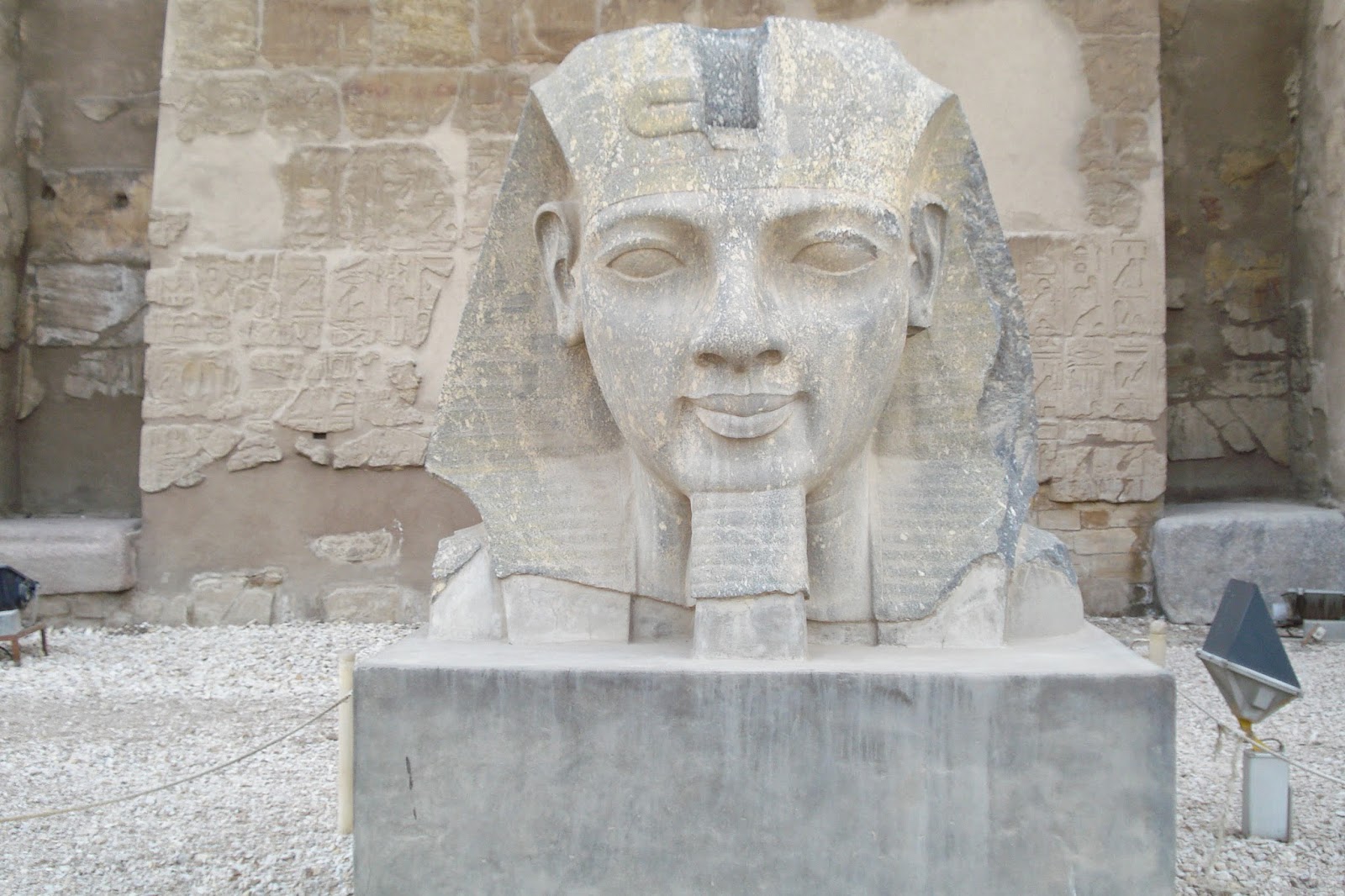
We entered through the gates past a giant Sphinx  who greeted us with its enigmatic smile.


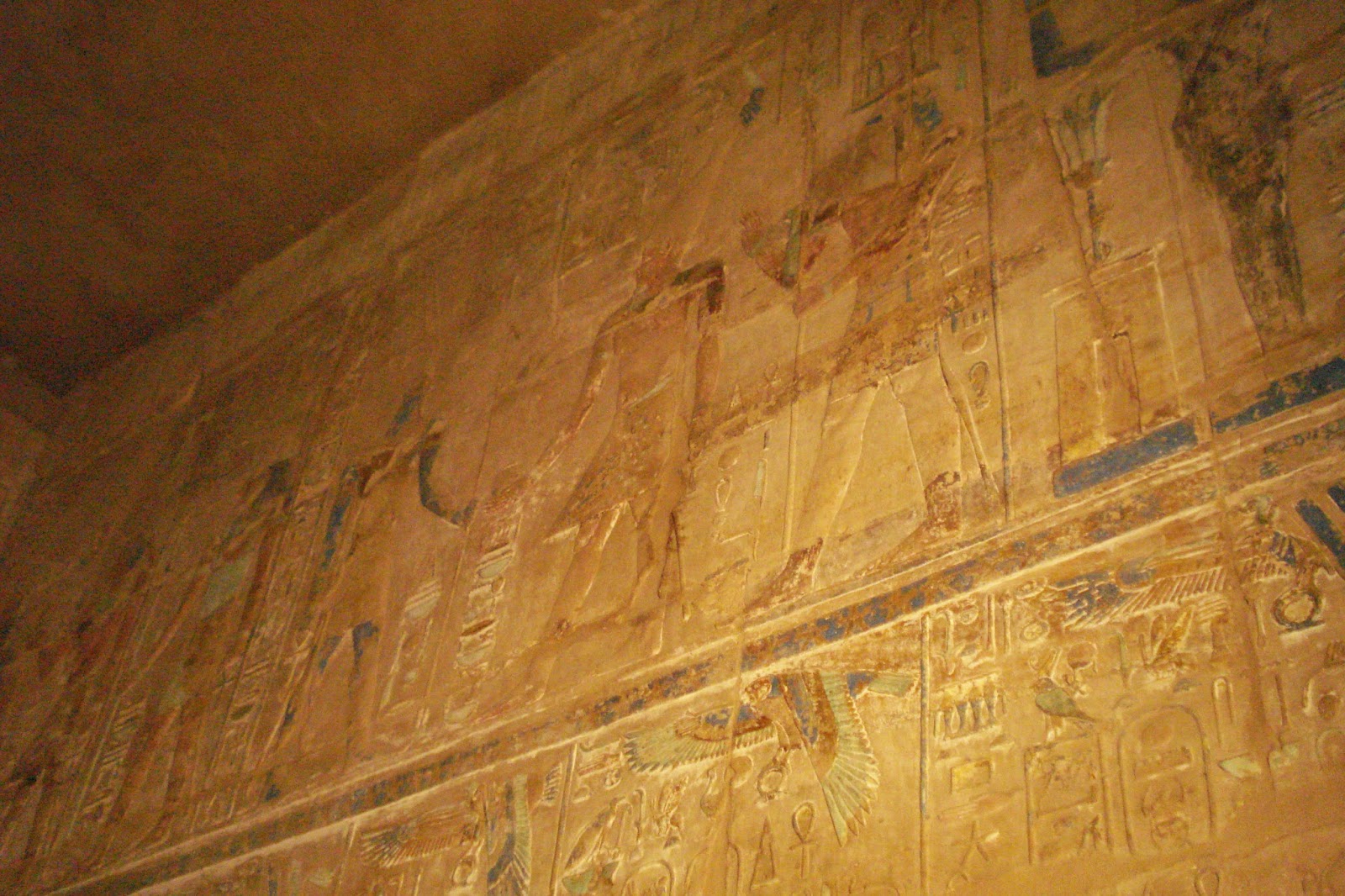
I was so excited when our Egyptologist, Hanan, led me into one of the inner chambers and pointed out the hieroglyphics on the wall that told of the arrival of Alexander the Great. Alexander visited there when he was on his Persian campaigns, stopping by Egypt to drive out the Persians who had invaded the country years before.  The Egyptians adored and honoured him, naming Alexander after Horus, the Son of God.  There on the wall, Hanan pointed out, was Alexander’s cartouche!  Below it some Greek visitors from the 1800’s had engraved their own names. Alexander dedicated one of the temple’s antechambers to the Sacred boat of Amun a replica of the god’s solar boat used during religious celebrations.

 
Greek graffiti
 

During the Roman period (284-105 AD) the temple was used as a military camp. There are still some restored paintings from that period at one end of the main building.  Later it was used as a church by the Christians and after that the Mosque of Abdul Haggag was built which stands alongside the temple wall.
 
 Mosque of Abdul Haggag


 North of Luxor’s city centre is Karnak, one of the largest religious complexes.  It was known as Ipet Isut which meant ‘the most select of places’. Over the years it was enlarged by various Pharaoh’s. It covered an area of 247 acres built around the Temple of Amun, and served as a spiritual centre and economic hub composed of temples , obelisks, pylons, courts, colonnades, halls, reliefs and sanctuaries.


As I approached it, down the long avenue of sphinx-like animals, I could not help but feel a bit overwhelmed.  The grandest feature of Karnak is the Great Hypostyle Hall which has 135 columns and includes the chapel of Senusert dating back to the Middle Kingdom. 
 

(sorry will fix later)


I was amazed at the massive height of the obelisks that tower over the buildings, one dedicated to Thutmose I and Hatshepsut  and one named ‘the botanical garden of Thumose II’ which is decorated with reliefs of plants, tress and animals
 

After this exhilarating and somewhat exhausting day of touring, we returned to the ship for dinner. We spent a relaxing evening in the bar entertained by a a belly dancer and the most amazing whirling dervish who could spin himself so fast he was a blur like a spinning top! 


NEXT: Tomorrow we disembark the ship and begin a cross-desert safari to the Red Sea.


Tuesday, May 06, 2014

THE SACRED VALLEY OF THE KINGS


After our visit to Kom Ombo and Edfu, we sailed down the Nile to Luxor where we would spend the morning touring the famous Valley of the Kings.


The landscape of Egypt is astonishing with its buff-coloured rolling dunes, wide stretches of sandy wilderness, and cutting through this the wide, beautiful Nile River.  All along the river’s banks is lush greenery: palm and date groves, sugar cane, fields of agriculture. At the shore cattle and goats graze among the swampy marshes and egrets perch in the tall papyrus and reeds. 


The Valley of the Kings is on the west bank of the Nile across from Thebes (Luxor) in the heart of the Theban Necropolis. It consists of two valleys, the east, where the majority of the royal tombs are situated, and the West. The Valley was used for burials from about 1539 BC to 1075 BC. It contains around 60 tombs starting with Thutmose I and ending with Ramses X or XI. This is the wadi (valley) where archaeologists discovered the tomb of Tutankhamen. It is one of the most famous archaeological sites in the world, now named a World Heritage Site.
 
site attendant
We weren’t allowed to take photos inside the tombs. We visited three tombs: Ramses IV, Ramses II and Ramses IX. All were filled with beautiful hieroglyphics still with their original colours, describing details of each toe, mainly to do with the Book of the Dead. We were able to see the outer part of the tomb of Tutankhamun, discovered in 1922 by Howard Carter. Later we would see all the priceless tomb finds in the Cairo Museum. (Since our visit I saw some photos of the reconstructions that are being done inside the tomb so when it is open for viewing again you’ll be able to get a clear idea of just what it was like when King Tut was buried there.)
Marko takes photos outside the tombs


 The Egyptologist told us there are many tombs still undiscovered in those hills.


Beside the Valley of the Kings is the Valley of the Queens where the wives of the Pharaohs and their children were buried. It was known as Ta-Set-Neferu meaning “The place of the Children of the Pharaohs. 

 The Temple of Hatshepsut
 
 
One of the most spectacular sights that will stay forever in my memory in the Valley of the Kings is the amazing, well preserved Temple of Hatshepsut. This is considered to be the finest building of antiquity in Egypt. The temple is set in a great amphitheatre surrounded by high dunes and rock formations that form an amphitheatre behind it.


Back in the 1970 ‘s I had read a book by author Pauline Gedge. “Child of the Morning”  was the story of the child who became first a queen and then a pharaoh, Hatshepsut. Perhaps it was that book that captivated my interest in ancient Egypt. But how did I know then that one day I’d be standing right in front of this fabulous monument left in her memory.


As I approached the temple down the sphinx-lined avenue and up the monumental ramp leading to the three wide terraces, I was almost speechless and overcome with emotion. To think that here I was, entering Hatshepsut’s sacred precinct. It was almost surreal, and definitely a moment in time that will never be forgotten!
 
The terraces of the temple are flanked with porticos and rows of Doric columns. There are rows of statues, some with faint traces of ochre indicating that at one time they were painted. There are fascinating carved reliefs on the second terrace that depict a maritime expedition to the land of Punt (Sudan) and show the exotic gifts: ivory, ebony, wild cats and incense that the Queen of Punt had sent back to Egypt. The temple was designed  by the queen’s steward and architect, Senenmut. It took eight years to build, a fitting tribute to the woman who ruled Egypt as pharaoh for nearly half a century (1501-1452 BC)  Hatshepsut called it “The Splendor of Splendors”. It is still considered one of the most striking architectural works on earth.
 
 
Heiroglyphics

We visited the tomb of one of the Egyptian princes who was the son of Ramses III. Inside were beautiful paintings and a tiny fetus in a glass case.

After this memorable morning we headed back to the cruise ship for lunch. In the afternoon we will visit Luxor and the Temple of Karnak.


Thursday, April 24, 2014

THE CROCODILE TEMPLE AT KOM OMBO


Getting ready for another exciting tour!
 
Our next archaeological destination was the ancient site of Kom Ombo.

Kom Ombo was situated at an important crossroads between the caravan route from Nubia and routes from the gold mines in the eastern desert. At one time, during the reign of Ptolemy VI (180-145 BC) it was a training depot for African war elephants.

Kom Ombo
Today Kom Ombo is the home of many Nubians who were displaced after the Aswan Dam flooded their lands. They now work in the tourism industry or the sugar cane fields on the river banks. There are also felucca-building yards at Edfu and many Nubians are helmsmen on the river boats.
 

On our way to Kom Ombo we passed by the Colossi of Memnon, two giant monoliths that stand by the road guarding the Theban Necropolis all that remains of a temple built by Amenophis II about 2400 years ago.
The Collosi of Thebes


We entered the temple complex through the remains of the monumental Gate of Neos Dionysos.  Much of the temple has been washed away by Nile floods so only low walls and stumps of pillars in the forecourt remain.  But in the beautiful Outer Hypostyle Hall there are fifteen sturdy columns still standing, with decorated cornices and carved winged sun disks.  The papyrus is the symbol of the Nile Delta and the bases of these columns are carved with the heraldic lily of Upper Egypt and the papyrus.

Temple Column

Me at the Temple of Kom Ombo

Kom Ombo Temple is an usual double temple built during the Ptolemaic dynasty, with later additions by the Romans. It has courts, halls, sanctuaries and rooms duplicated for two sets of gods. The right side is dedicated to Sobek-Re (the crocodile god combined with the sun god Re) along with his wife and their son. Sobek is associated with Seth, the murderer of Osiris and enemy of Horus. In the myth, Seth changed himself into a crocodile to escape. The Egyptians believed if they honored the crocodile as a god they would be safe from attacks by the ferocious creatures.
Nubians
The left side of the temple is dedicated to the falcon god Haroeris “The Good Doctor” (Horus the Elder) along with his consort Ta-Sent-Nefer,“the Good Sister” (another form of Hathor) and Panebtawy, Lord of the Two Lands.
Hanan explains the heiroglyphics to Linda 


Our Egyptologist guide, Hanan, made the tour through the temples interesting by telling the stories etched in the hieroglyphs. There is a relief of Sobek in his snake form on one wall and another shows Ptolemy II making offerings to various gods. The scene on the face of the rear wall was interesting as it may have represented a set of surgical instruments.
 
 
As we had sailed down the Nile, of course I didn't see any crocodiles – until we reached Kom Ombo and there, to my surprise, was a whole temple full of them! They were mummified, of course, but pretty lethal looking just the same!
Mummified Crocodiles

In ancient times, this part of the Nile was known for the crocodiles that basked in the sun posing a threat to the locals. This is likely why one of the temples at Kom Ombo is dedicated to Sobek, the crocodile god.


After this interesting tour, we returned to the boat and lounged on the deck for a while before heading off for EDFU. 


 Linda, Yves and me relaxing on deck


By Horse and Carriage to Edfu
 
Edfu


Edfu is a small city located on the west bank of the Nile River north of Aswan. This time we were transported by horse and carriage which made it a unique and extra fun experience.  We were swarmed by Nubian souvenier-sellers but politely declined their wares. One young boy caught my attention though. As charming as could be, he kept saying to me “You have a lovely smile, lady! Smile again!” Of course he wanted me to buy some trinkets, and eventually I just couldn’t resist his charm!

The Carriage Ride
 

The cute souvenier seller

The Edfu site has provided archaeologists with more information than many others, dating from as far back as the Predynastic Period right until the Byzantine era. Edfu was the capital of that area of Upper Egypt and one of the few settlements that thrived when others were in decline.


The Temple in Edfu is located on the west bank of the Nile which was known in Greco-Roman times as Apollonopolis Magna, after the chief god,  Horus-Opollo. This is one of the best preserved temples in Egypt. It was built in the Ptolemaic period between 237 – 57 BC and dedicated to the falcon god Horus.

Because the temple is so well preserved it is a frequent stop for many of the river cruises and tour groups. The day we were there though there were few others,  one of the significant examples of how the tourism in Egypt has suffered in the last two years.

The temple of Edfu is the largest temple dedicated to the gods Horus and Hathor and was the centre of sacred festivals to honour the gods’ sacred marriage. The ancient Egyptians believed that each year Hathor travelled south from her temple at Denderah to visit Horus at Edfu. It was an important festival  and pilgrimage.
 
Me and Horus

What makes this temple unique are the inscriptions on the iwalls which provide important information on language, myth and religion during that period in ancient Egypt. The most unique thing is the inscribed building texts that provide details of the temple’s construction and information about the mythical interpretations.


Hanan pointed out the important scenes and inscription that told the age-old conflict between Horus and Seth. (Seth was the god who killed Horus’ father, his own brother Osiris).

It was such an intense and interesting day of touring that when we got back to the ship in the evening none of us had the energy to join in a “Gallabia Party”.  I peeked in to see though. Everyone was dressed in Egyptian costumes and having a great time dancing to Egyptian music. I kind of wished I’d had the energy to attend as it looked like everyone was having a lot of fun.  But we needed a good night’s sleep because the next day we were headed for Luxor and the Valley of the Kings!
The Egyptian Party


Nile Sunset


NEXT: THE VALLEY OF THE KINGS AND THE AMAZING TEMPLE OF HATSHEPSUT