Total Pageviews

Showing posts with label explore. Show all posts

Tuesday, August 21, 2018

Travel writing thru the Centuries


TRAVEL WRITING THRU THE CENTURIES
Adventures in Egypt and Morocco from the 1600’s to the turn of the 20th century


Two years ago I was offered a series of books published by the American University in Cairo Press.  The first set of books included poetry and diary excerpts from travelers in Egypt from the 1700’s to the 19th century.  

WOMEN TRAVELERS ON THE NILE (edited by Deborah Manley) is an anthology of journal excerpts and stories written by women who were brave enough to venture into a world that until then had mainly been explored by men.  Some of them accompanied their husbands., others bravely ventured out alone, in the company of Egyptian guides. Many of them ended up living in Egypt and contributed more insights into Egyptian life, especially from a woman’s perspective.  They learned Arabic and met both the poorer women and the richest.  Some of these women were invited to join groups or to accompany their husbands. Some wrote books about their travels, others made notes in journals. 


I was privileged in 2014 to be invited on a small travel journalist’s tour of Egypt offered by the Egyptian Tourism in Ottawa, Canada.  This was a dream come true for me.  Not only had I been fascinated with Egypt and Egyptian history for years, but I had recently completed on novel about Alexander the Great (SHADOW OF THE LION) which is partly set in Egypt at the time the city of Alexandria was being built by Ptolemy 1st according to Alexander’s wishes.
Because of my own unforgettable adventures on that 10-day trip, I was fascinated to read the stories of these women who had journeyed, often alone, into the desert by camel and lived in these ancient communities. Seeing Egypt through their eyes was a real pleasure.

The women travelers included Emily Anne Beaufort (1826-1887) daughter of the creator of the Beaufort Wind Scale; Sarah Belzoni (1785-1970) wife of a famous Egyptian explorer; Isabella Bird (1831-1904) one of the greatest Victorian era travel writers; M.L.M. Carey (1860-?) a writer an artist; Eliza Fay (1756-1816) an adventurous woman who also accompanied her husband to India in 1799, Marianne North (1830 -90) one of the most intrepid of the Victorian lady travelers. Mary Whatley (1824-89() who set up schools for poor Egyptian girls, as well as many others. 


ANCIENT EGYPT IN POETRY, is an anthology of Nineteenth Century Verse. (edited by Donald P. Ryan) Intrigued by the history and ancient ruins of Egypt, many writers over the years have visited Egypt, attracted by the adventure and ancient intrigue found in the remarkable archaeological sites and the fascinating desert landscapes. During the nineteenth century Egypt was in particular a popular destination for poets, writers and artists. 
Some of the poets who traveled there whose work is included in the book are Thomas Bailey Aldrich (1836-1907), an American poet, newspaper and magazine editor and Civil War correspondent wo visited Egypt in 1905; Charles Dent Bell (1818-98) an Irish vicar who was inspired by nature; Robert Browning (1812-89) one of the greatest literary figures in English language, Lord Byron (1788-1824) one of the greatest Romantic Era poets; Mary Elizabeth Coleridge (1861-1907) noted for her compassion toward the poor and uneducated; John Keats (1795-1821) one of the great Romantic Era poets of England; Henry Wadsworth Longfellow (1897-82)one of Americas greatest poets; Herman Melville (1819-91) author of Moby Dick and Typee; Percy Bysshe Shelley (1792-1822) noted English poet and Alfred Tennyson  (1809-92) poet laureate of the United Kingdom. 
These two books are pocket-sized, quick-reads, making them handy to take along in your purse or back-pack. 


ARISTOCRATS AND ARCHAEOLOGIST:  An Edwardian Journey on the Nile  (edited by Toby Wilkinson and Julian Platt) is a fascinating journal recording an Edwardian doctor’s journey on the Nile in the winter of 1907 – 1908, complied of a series of letters that give a first-hand account of the three-month trip, sites visited, passengers on board and people encountered along the journey as well encounters with cultural and class differences. The collection of letters was written by “Ferdy”, the great uncle of Julian Platt. During the early 1900’s people often escaped the cold dank winters of England and the many illnesses that often-ravaged Europe and spent the winter months in warmer climes. “Ferdy” (Ferdinand) A.F.R. Platt was a physician who accompanied the wealthy Duke of Devonshire on a journey to Egypt. It’s a delightful read and includes maps and itinerary notes and photographs of all Platt’s adventures as they cruised the Nile.


The most recent book I received from Cairo Press is another tiny gem, A MOROCCO ANTHOLOGY (edited by Martin Rose).  I found this book just as intriguing as the Egyptian books as I have also traveled to Morocco several years ago. It’s a book I’d like to have read before I made that trekking journey into the foothills of the High Atlas from Marrakech.  
Morocco has four ‘imperial cities’ where the sultan’s court settled in past times. This book includes visits to the various cities by adventurers, travel writers and others to these fabled cities. Morocco had a French and Spanish colonial period that lasted 44 years.  Writer Edith Wharton wrote “a country so deeply conditioned by its miles and miles of uncitied wilderness that until one has know the wilderness one cannot understand the cities”.  This little book takes you on a journey to each of these cities and explores the point of view of these travelers from long ago. 


 Some of these contributors include Ali Bey Al-Abbassi (1767-1818) a Spaniard from Barcelona, who visited Morocco between 1803-1805; Ellis Ashmea-Bartlett (1888-1931) a war correspondent who worked for Reuters.;  Paul Bowles (1910-0=99 an American novelist, composer, musician, poet and translator; Walter Harris (1866-1933) a Times  correspondent who traveled in disguise to meet sultans and rebels; Emily Keen, Shareefa of Ouazzane (1850-1941) an English governess who married the Grand Sheikh of Ouazzane’; Pierre Loti (1850-1923) a French navel officer and novelist; Samuel Pepys (1633-1703) a diarist; Edith Wharton (1862-1937) American writer who won the Pulitzer Prize for The Age of Innocence.  
This books takes you on an exotic journey to all of the imperial cities of Morocco and gives some insight into what life was like back in the past from the journals of these interesting writers.

Add to Technorati Favorites

Tuesday, August 23, 2016

MAKING TRIP PLANS, 2016

Add to Technorati FavoritesENGLAND AND THE IONIAN ISLANDS

I've started to verify and plan my trip to Europe this year which will begin September 4 when I fly to London.  From there I will go right away to Caerphilly, Wales to spend a couple of days visiting with my cousins and touring my castle.  It's a quick trip due to me having to take advantage of cheap air fares.
 Caerphilly Castle

 Windsor St. Where my Dad used to live.

On Sept. 7 I'll head into London again, early, in time to take in a special exhibit at the British Museum.  I'm really excited about seeing EGYPT'S LOST WORLDS, which are artifacts found under the see, some off of Alexandria which was the city founded by Alexander the Great and occupied but the first Ptolemaic dynasty of Egypt.
 The British Museum


Early the next morning I fly to Corfu, my first stop in the Ionian Islands off the west coast of Greece. I was only there briefly back in the early '80's so I wanted to spend a few days there as Corfu has an interesting history with lots to see. I've check out the tours and will try and take one of them so I can see as many of the special sites as possible.  This will include the palace where Prince Philip was born and the home of the Durrell brothers of literary fame.
 Corfu, Kerkyra
 Mouse Island


 Kerkyra

I'm staying on Corfu for 3 days then taking the quick ferry over to the tiny island of Paxis where I'll spend two days exploring. There are a couple of interesting museums and a Venetian Kastro on an islet off shore that was reputedly designed by Leonardo da Vinci. 
 Paxi, Gaia

 Paxi harbour

From Paxi I must take a ferry to the mainland and then a bus to Lefkada where I'll head south to the town of Vassiliki (the surf-boarders paradise). Not sure yet if I'll spend a night there. It depends on the ferry service onward to Kefalonia where I will visit the seaside town of Fiscardo, established and named for a famous pirate. 

From there I will head by bus to Athens, and will stop there to visit friends for a few days before heading on another island adventure,  this time to the islands of Paros and Naxos.  I decided to stay two days on Paros as it is another island that I've only visited briefly back in the '90's.

My favorite island is Naxos, so I'll stay there five days in a bed-tent at the Maragas Camping, a campsite and beach that I just love going to. I never get tired of visiting Naxos as it's a big island and lots to see besides having the most fabulous beaches!  I can hardly wait to have my dinner at one of my favorite sea-side tavernas there to watch the sunset!

From Naxos I will head south to Crete.  I haven't been to Crete since the '80's and wanted to see the Minoan site of Knossos again as well as exploring around Iraklion.  I'll be there a couple of days and hope to get up to a mountainside resort owned by a FB friend.

When all my Cretan adventures are over, I head back to Athens and that's where I'll be for the month of October, until the 20th when I head back home.  There's lots to see and do in my favorite city besides visiting with my friends.  I'll go over to Salamina island for a few days to explore with Christina and probably make a few day trips around  If finances enable it, I might even go up to Pelion for a few days as I've been wanting to explore that area for quite some time now. 

Some of my Athens friends
 Zoe and me
 Carola, Christina and Kim

I'll be posting along the way and sharing all my adventures with on-line friends and family. So stay tuned for the next installment! IF YOU WANT FURTHER INFO ON SAVING MONEY WHILE YOU TRAVEL CHECK THESE LINKS. A little bit more information about our guide: It breakdowns when a no foreign transaction credit card makes sense for travellers, their benefits, as well as strategies to save money when traveling abroad. You can see our work here: https://creditcards.usnews.com/no-foreign-transaction-fee https://creditcards.usnews.com/no-foreign-transaction-fee#what-are-foreign-transaction-fees https://creditcards.usnews.com/no-foreign-transaction-fee#choosing-card-no-foreign-transaction-fee https://creditcards.usnews.com/no-foreign-transaction-fee#best-credit-cards-with-no-foreign-transaction-fee

Thursday, July 28, 2016

A FEW LOVELY DAYS IN MALAGA, SEPT 2015

I've been remiss in posting blogs since I learned that had to move in January and things got a bit hectic from then til moving day April 1. Now that I'm settled in my new place, things are getting back into my usual routines of writing.  I'm finishing up old tasks and have been working on a new e-book for Hunter Publishing, a guide to the Greek Islands. And in just a few more weeks I'll be departing on another trip overseas, this time to mainly visit some of the islands as well as my friends in Athens.

First, though, I decided to post a few photos and memories of MALAGA, SPAIN, a city that I really fell in love with and would like to think I could return some day.  I spent three days there last September visiting my friends Carlos and Natalia and had a wonderful time.  Here's a few of the highlights.

My first panoramic view of the city convinced me it was going to a place I'd love to explore.


Malaga is one of the oldest cities in the world, first settled by the Phoenicians in about 770 BC. They called it Malaka  because of the fish that was salted at the harbor.  Later it fell into the hands of the Greeks, then the Romans until the Moors took over. It was under Islamic rule for 800 years.  So there are many ruins in Malaga which interested an archaeology buff like me.

The Roman Theatre dates from the 1st century BC

In te 8th century AD when the Muslim Arabic rule took over, the city became in important trade centre. The Moors left behind some outstanding structures, mainly the Castle of 'Gibralfaro which is connected to the Alcazaba the lower fortress and royal residence.
 The Fortress


Walking up to the Alcazaba
The Alcazaba was built on a quadrangular plan, protected by an outer and inner wall supported by towers,between which a covered walkway led up the slope to the Gibralfaro Castle.  It's an enjoyable trek up with some good panoramic views as a reward, plus a stroll through some lovely gardens.


Besides the archaeological sites of Malaga there are many other interesting places to explore.  We wandered through plazas where people were enjoying an afternoon drink of wine and tapas,  we passed by some old Churches and market squares, and down palm-lined pathways.  There are various museums including the Pablo Picasso Museum and I even had my photo taken with him!  And, we visited the old bodega (wine shop) in Malaga.  That was very interesting! Barrels and barrels of wine


 Pablo and me


 The Oldest Bodega in Malaga
Of course there were the days by the seaside as well and a trip to the nearby resort town of Bandalmadena.   It was crowded with tourists as are most of the seaside resorts near Malaga.  If you've ever visited there  you'll understand why it's a place that attracts so many tourists. I loved it!
Bandalmadena

Friday, May 22, 2015

EXPLORING SALAMINA


 Boat in Piraeus Port 

Salamina (Salamis) is the largest Greek island in the Saronic Gulf about 2 km off the coast from Piraeus. My friend Christina lives on Salamina so each time I visit Greece I always enjoy a few days on the island with her.

Last September when I was there we decided to do some exploring.  Salamina is a large island with an interesting history dating back to the Bronze Age. It is best known for the Battle of Salamis in 480 BC when the allied Greek fleet led by Themistocles, overpowered the Persian fleet. Today Salamis is the home of the Salamis Naval Base and a NATO base.


The island is one of the largest Greek islands with an area of 36 square miles.  It is mountainous and covered with pine forest. It's popular for holiday and weekend visits for Greeks from the mainland but not many tourists visit there. There is an island bus service but to really see around you need a car to reach some of the lovely more remote beaches around the island.

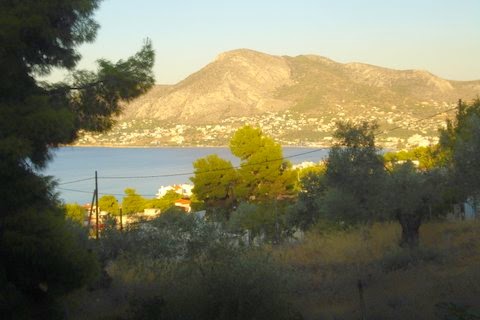
View from Christina's house

Christina's house is in the village of Aianteio on the southwestern part of the island. Her house has a magnificent view of the bay below and down the hill is a small, pleasant beach. This time when I visited Christina suggested we go exploring and see if we could find some of the ancient sites. According to the map there are several but they are not well marked so you need to be prepared to do some searching and hiking.


Our first stop was to go to the memorial for the Greek fleet from the Battle of Salamis.  Along the shore there is a memorial and nearby  tumulus where the dead were buried. Higher up on the hill is a beautiful bronze statue depicting the sailors aboard a ship.

Monument Honoring the Greek Fleet from the Battle of Salamis

From there we drove around to another part of the island, this time in search of  the ancient Mycenaean acropolis at Kanakia. The acropolis was on a hillside near the beach, but farther up the hill there are excavations and a memorial to Ajax, one of the warrior-kings who took part in the Trojan Wars. He is mentioned in Homer's Iliad and died at Troy, so a memorial had been built for him.


We found a dusty road leading up to where we supposed the excavations were and when we reached the top I heard some digging. Through the trees we could see some young people at work. They were the archaeology team.  So we went to investigate. And what luck! I just happened that the archaeologist was there, Yannos Lolos, who is well known for his discoveries. He welcomed us to the site and showed us around. When I mentioned my novel Shadow of the Lion which had just been published, he was very interested. That was definitely one of the highlights of my trip last year!
Archaeologist at Work 
Other interesting sites on the island include the Cave of Euripides. The poet was born on Salamis and this cave is where he wrote most of his works.  Christina has been there but said it was a difficult trudge up the mountain so we passed on that idea and went in search of a nice beach where we could refresh ourselves.


Salamina has several very pleasant beaches and we enjoyed a nice feast of Greek mezedes at the beach taverna in Kanakia before driving around to see more sites.

 One of many beautiful views

 The Monastary

A very old church dating to 1000's.


Home of the poet Angelos Sikelianos

Along the way we stopped at The Monastery of Virgin Mary Faneromeni that played a role in the Greek War of Independence in 1821 against the Turks. Nearby on the beach is the house of the distinguished poet Angelos Sikelianos . The author wrote many of his remarkable pieces here. It is now a museum


 Beautiful Views on the Island Drive

Church of the Virgin Mary Eleftherotria

On the way back to Salamina town we drove up into the hills to see the Euripidean Theatre and the beautiful Church of Virgin Mary Eleftherotria on the Patris Hill. The views from there were spectacular.

Back in town we visited the Folk Museum and also the archaeological museum that had displays from the Cave of Euripides and other excavations on the island.


Across the road we found a quaint old taverna and were welcomed in. It was like a mini museum with all kinds of Greek artifacts hanging from the rafters and decorating the walls.  The owner was a very friendly fellow and we decided this would be a great place to visit again. (Maybe this year we'll go there).

 The taverna in Salamis

Christina and me having fun

As usual my time on Salamina was full of fun and never a dull moment. It's always nice to get back to Chris's house and relax on her porch swing watching the collection of neighbourhood cats that like to come and visit. When I got back this year we plan to do more exploring as there are still a lot of undiscovered places to see.
 The Cats
 Feeding Time
 The little courtyard and the suite I stay in
 The terrace
Christina's beautiful house

Here's a link to a published story about Salamina: http://www.travelgeneration.com/travel-stories/greece-the-hidden-treasures-and-secrets-of-salamina/