Total Pageviews

Showing posts with label tombs. Show all posts

Tuesday, February 17, 2015

ATHENS ANCIENT CITY WALL and the KERAMEIKOS


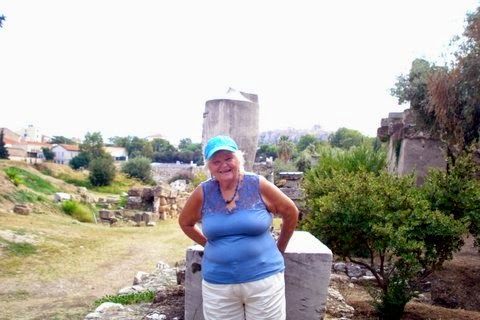
Just west, beyond  Monastiraki and Thissio along Ermou Street, is the ancient city wall of Athens and the great Dipylon Gate, once the busiest part of the city.  The road from Pireaus and Eleusis lead here. Next to it is the Sacred Gate, a ceremonial entrance or "Sacred Way" used for the Panathenai and Eleusinian processionals. Between the two gates are the foundations of a building known as the Pompeion where preparations for the processionals were made.


City Wall

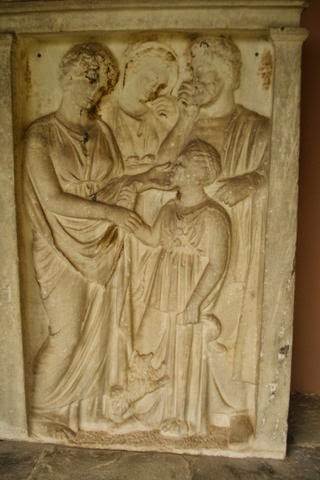
Along the area near the Kermeikos is where the potters of ancient Athens had their shops and plied their trade (ceramics= keramikos) .  The area, called Kermeikos, just outside the gates, is where the Street of Tombs was located.  Here wealthy and important families buried their dead marking the way with elaborate statuary.  Many of these still survive making it an interesting place to walk about.


The site, along these important roads that led into the city, was a prestigious one. Among the grave markers are the flat, vertical stele of the Classical period and sarcophagi from later Hellenistic and Roman times. Some of the monuments are memorials to soldiers killed in wars such as the large tomb with a semicircular base as you enter the pathway, a Memorial to Dexileos, a 20-year old who was killed in battle in Corinth in 394 BC.  Adjacent to it is the Monument of Dionysios of Kollytos, a pillar stele supporting a bull carved from Pentelic marble.


I love wandering around the Kerameikos, exploring the many grave monuments and imagining life as it must have been, the bustle of people coming and going on those roads.  One of the roads leads to Plato's Academy. Imagine the philosopher and his followers walking there on their way to the Agora.


There's a museum on the site too and it contains many of the interesting artifacts collected from the area including some beautiful ceramics and burial finds such as children's toys, jewelry and other objects.


The site is open daily April - Sept 8 am - 7.30 pm, Oct - March 8.30 am - 3 pm. The museum opens at 11 am. Admission  2 Euro or it is included in a joint Acropolis ticket.

Sunday, August 10, 2014

MORE TREASURES OF ANCIENT EGYPT: SAQQARA AND MEMPHIS


SAQQARA

Most of the remnants of ancient Egypt lay scattered on the desert plateau south of Cairo. After visiting the amazing pyramids of Giza we went to see the amazing necropolis at Saqara and the Step Pyramid of King  Djoser that was 'built to last til the ends of time'. This is the largest necropolis in Egypt, extending for almost five miles. It's a collection of pyramids, temples and tombs including the Mastaba tombs where the high officials of the Pharaohs were buried. These are comprised of several chambers with walls covered with reliefs that detail scenes of hunting and fishing and everyday life in ancient Egypt.


Step pyramid

The step-pyramid  is the oldest pyramid found in Egypt, over 2,000 years. What was amazing to me is that it reminded me of the type of pyramids you find in Mayan ruins in Mexico, with steps leading to the top. Although the third dynasty began with the Pharaoh Sanakht the real founder is considered to be Djoser, a name derived from "geser" meaning "sacred"  Just as Ramses II is associated with Abu Simbel, Djoser is identified by Saqqara's architectural monument. It is the oldest structure in the world build entirely of stone. It is 62 metres high and the base measures 109 by 125 metres. The burial chamber of the Pharaoh was located at the centre of the pyramid at the bottom of a large vertical shat 28 metres deep. From here a labyrinth of rooms, corridors, chambers and passageways protected the tombs


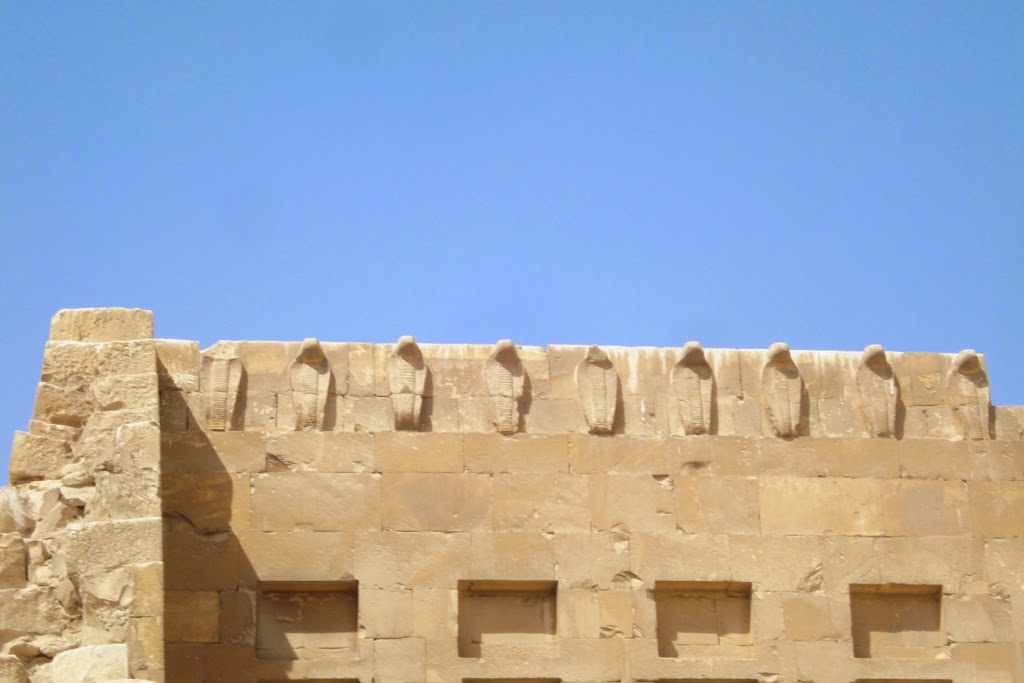
Cobras decorate the roof
Burial chambers


MEMPHIS


You know that song "We're going to Memphis"? Well Memphis, in ancient Egypt was once the capital city. According to legend it was founded by pharaoh Menes around 3000 BC and was the capital of Egypt during the Old Kingdom, remaining an important city throughout history. During the 6th dynasty it was a centre for the worship of Ptah, the god of creation and artworks. There is an alabaster Sphinx guarding the Temple of Ptah that is a memorial of the city's former power and prestige.


alabaster statue of Ramses II


I was particularly interested in visiting this ancient city, because it was where Alexander the Great came after he had successfully driven the Persian out of Egypt.  Part of the mystique of Alexander is his connection to Nectanebo II, a shaman pharaoh of Memphis who had fled to Macedon to plead with Alexander's father Philip II to help drive the Persian out of his country.  Rumours abounded for most of Alexander's life that he was Nectanabo's son because during the Pharaoh's stay in Macedon, Alexander's mother, Olympias, then a young bride of Philip, may have had an affair with the pharaoh. She was reputedly told by him that she would be visited by the golden snake of Ammon and give birth to a miraculous son.  After Philip was assassinated and Alexander became king, he led his army south down the coast of Asia Minor, across Gaza and successfully vanquished the Persians. He was honored by the Egyptians and crowned pharaoh in the Temple of Ptah, ushering in the Hellensitic period. . From then on he wore the Horns of Ammon on his helmet. After his famous visit to the oasis shrine of Siwah where he would consult the oracle about his birthright, he learned information that he wouldn't even indulge to his best friend but said he'd wait til he got back home to discuss it with his mother.


Alexander wanted to establish a city in Egypt. Memphis was too far inland, south of the delta, so he chose the site by the sea that is now Alexandria. When Alexander died in 323 BC, his illegitimate half-brother Ptolemy came to Egypt to establish the city of Alexandria. For a time he kept Alexander's body at Memphis but it was later moved to the new city. This began the Ptolemaic dynasty of Egypt. Ptolemy established the cult of Serapis in Egypt at Saqqara.

Memphis thrived until the arrival of the Romans when it lost it's importance in favour of Alexandria.

 
NEXT: At Last, ALEXANDRIA!


Monday, November 26, 2012

THE WONDERS OF KING TUT’S TOMB


Tutankhamun was an Egyptian pharaoh of the 18th dynasty known as the New Kingdom. His name means “Living Image of Aten”, although he is popularly known as “King Tut”. He was the son of Akhenaten and one of Akhenaten’s sisters. He ascended the throne in 11333 BC at the age of nine or ten. When he became king, he married his half-sister. They had two daughters, both stillborn.

There is some believe that because Tutankhamun was the result of an incestuous relationship he may have suffered some several genetic defects that contributed to his early death. He was slight of build and about 5 ft 11 in (180 cm) tall. Research showed that he had a slight cleft palate and possibly a mild case of scoliosis. He died at the age of 19. For years, scientists have tried to unravel clues as to why the boy king died. There were several theories, one that he was killed by a blow to his head, another that his death was caused by a broken leg.  There was also the possibility of various diseases including sickle cell disease.

There are no surviving records of Tutankhamun’s final days. There was some speculation that he might have been assassinated but the general consensus is that his death ws accidental.  He was buried in a tomb that was small considering his status. Perhaps his death was unexpected before they could complete a grander royal tomb.  He faded from public interest in Ancient Egypt within a short time after his death and remained virtually unknown until the 1920’s when his tomb was found in the Valley of the Kings. His tomb was found by explorers Howard Carter and George Herbert, 5th Earl of Carnarvon in     1922.  Although it had likely been robbed at least twice in antiquity, probably soon after the initial burial, the tomb was filled with priceless treasures.

Tutankhamun’s mummy rested in his tomb i the Valley of the Kings until November 4, 2007, 85 years to the day after Carter’s discovery, when it went on display inthe underground tomb at Luxor, when the linen-wrapped mummy was removed from its golden sarcophagus to a climbate-controlled glass box designed to prevent decomposition caused by humidity and warmth from tourists visiting the tomb.  His tomb is among the best preserved. Relics from the tomb are among the most traveled artifacts in the world.
Jewelled scarab
 
Last month I travelled to Seattle WA to see them for myself, on display at the Pacific Science Center. It was a huge thrill to step into history and see this grand exhibition.  The exhibition features more than 100 objects from King Tut’s tomb and other ancient sites that represent some of the most important rulers throughout 2,000 years of ancient Egyptian history. Many of the object had never been seen before in North America and include a 10 foot statue of the pharaoh found at the remains of the funerary temple of two of his high officials. There were displays of jewelry, furniture and ceremonial items including the boy king’s golden sandals which had been created specifically for the afterlife and still covered his feet when his mummified remains were discovered by Carter back in 1922.
King Tut's bed

Following the tour of the artifacts, there was an IMAX film, “Mummies: Secrets of the Pharaohs” that followed researchers and explorers as they pieced together the archaeological and genetic clues of Egyptian mummies.

The exhibition is open until January 6, 2013. Tickets are available on-line and include entrance to the Pacific Science Centre exhibits. www.pacificsciencecenter.org

Just this past week there was news that a copy of Tut’s original tomb is being built for tourists to view, in order to protect and preserve the original tomb. You can see a you-tube video about it here:


Note: No photos are allowed in the King Tut exhibit. Photos included here are from internet sources.