Total Pageviews

Showing posts with label baths. Show all posts

Sunday, April 05, 2015

THERMOPYLAE: VISITING A FAMOUS BATTLE SITE

The Battle of Thermopylae:  This famous battle was fought in 490 BC between an alliance of the Greek city states, led by King Leonidas of Sparta, and the Persians, led by Xerxes 1.  The battle took place over three days.
Battle site


The Greek force of approximately 7,000 men marched north to block the pass of Themopylae, which would simultaneously block the Persian navy at the Straits of Artemisium. According to some sources the Persian army was said to have numbered over one million but was likely much smaller (perhaps 1000,000 and 150,000).  The Greeks arrived at the pass some time in late August or early September and managed to hold off the Persians for seven days before the rear-guard was annihilated. During two full days of battle, a small force of Spartans lead by Leonidas blocked the road through the pass so the Persians could not enter. After the second day they were betrayed by a local resident named Ephialtes, who showed the Persians how to access the pass by a different route thereby cutting off and trapping the Greeks. Brave Leonidas, knowing that they were outflanked, sent back the bulk of the Greek army and stayed, with his 300 Spartans, 700 Thespiasn, and 400 Thebans to defend the pass. Most them, including the 300 Spartans, were killed.

 map of battle

The Pass 
Because our trip to the islands had been hindered by bad weather, after our bus tour group left the spa resort at Kamena Vourla, we were treated to a side-trip Thermopylae, known for its hot springs.
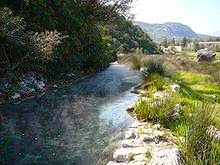
Thermopylae, known for its hot springs. It was also called the "Hot Gates" 

The day we were there

 We stopped  view the monument in honour of Leonidas and his brave Spartans, and a visit to the small museum where you can view videos explaining the whole battle.
Statue honouring Leonidas and the Spartans

Thermopylae Museum
There was also an amazing exhibit of helmets from bronze age to Classical and Hellenic eras.  The artist who made them was there to explain each one.  There were also interesting murals of battle scenes and other artifacts on view.
Museum exhibits and artwork


Spartan helmet

One of my favorite novels is 'GATES OF FIRE" by Steven Pressfield, who has been very supportive of me and my writing of Shadow of the Lion.  This book tells about the famous battle of Thermopylae and the life of the Spartans. I've also had the privilege of visiting Sparta on a couple of occasions. Although there are few ruins left it is interesting to see the location of their city. There is also a fine statue honouring Leonidas.

I was quite thrilled to get the chance to visit this new museum and if you are interested in this period of Greek history, I recommend you make the journey.  Up in the entrance to the pass there is also a monument to the 300 Spartans which I have seen on occasions when I took the bus from Northern Greece to the south.
(* note: some of these photos are from internet sources.)

Wednesday, July 08, 2009

BATH: The Roman Baths

THE ROMAN BATHS

Bath's Roman name was Aquae Sulis (the waters of Sulis) named after the Celtic goddess, Sulis. The building that houses the Roman baths is from the 18th century. There's a Georgian Pump Room on the ground floor. The baths are below street level and include four main features: the Sacred Spring; Roman temple, and the Roman bath houses.

The baths were not discovered and explored until th elate 19th century. Their complex structure allows you to glimpse the genius of the Romans who loved their baths and made it part of their daily ritual. (I've seen the ruins of Roman baths in Greece as well, however none so complex and beautiful as these at Bath).


BATHING ROOM

The baths were formed from the natural hot springs that the area is famous for. In the Sacred Spring, which is the heart of the site, the water temperature is 46C. The mineral rich water burbles up at the rate of 1,170,000 litres every day as it has for thousands of years.
SACRED SPRING

The Romans believed it was a work of the gods and built a Temple next to the spring dedicated to Sulis Minerva, a deity with healing powers. The first shrine at this site was built by Celts and dedicated to their goddess Sulis who the Romans identified with Minerva.

GORGON'S HEAD
The Gorgon's head was a powerful sign of Minerva and this carving has a distinctly Celtic style to it. The Temple was constructed in 60 - 70 AD and the bathing complex built up over the next 300 years. After the Romans withdrew from Britain in the first decade of the 5th C. the baths fell into disrepair and were probably destroyed in the 6th C. Over the centuries they were redeveloped and now are housed in 18th century buildings. They were a popular tourist destination in the 18th and 19th centuries.

If you go, allow yourself lots of time to browse around. It is truly one of the most fascinating sites I've ever visited. There are even a few "Romans" roaming around, dressed in togas.

We were limited in time at Bath because we wanted to make it to Salisbury and had to get back to London later that day to pick up our luggage and head for Wales. So, regretfully, we left this beautiful, interesting little town and headed back to the train station.


Add to Technorati Favorites
Posted by Picasa

BATH: A Short History of Bath Abbey


BATH ABBEY
Thursday, May 28
We had started out that morning intending to go to Salisbury (Old Sarum) but we got to the wrong train station in London. (We went to Pennington instead of Waterloo. Confusing!) The ticket seller suggested we should go to Bath, because he said it was much more interesting than trying to get to Old Sarum and Stonehenge. He said we could take the train from Bath to Salisbury. We decided to take his advice. I'd been to Bath several years ago with my friend Anne and we spent a couple of days there. I remembering having been quite impressed with the town and what there is to see there -- mainly the Roman baths.

One of the other big features in Bath is the impressive Bath Abbey. It dominates the town and has for many centuries. In fact, there's 1600 years of history in this magnificent church and, in the town itself, even older history.


THE NAVE, BATH ABBEY

A brief history of BATH:

AD 43: Romans invade Britain
60: Romans begin to develop Bath as a spa around Bath's hot springs. Bath becomes the centre of Pagan worship.
5th century: End of Roman Britain.
577 Saxons capture Bath
676 Convent of Christian nuns founded in Bath
757 Cynewulf, king of the Saxosn, grants land at Bath to the monks of St. Peter
973 in Bath Abbey, Edgar crowned as first king of E
1066 Norman conquest
1090's new cathedral founded
1499 Norman cathedral ruined. Present Abbey church founded to replace it.
1539 Bath Abbey largely destroyed
1611 Abbey restored
18th Century Abbey church popular with visitors thronging to Bath's spa.
1860 major restorations
1942 Bath bombed and Abbey damaged
1991-2000 Abbey restored. Mesuem opened. Organ rebuilt; capels dedicated,, new frontal for high altar.


THE HIGH ALTAR AND EAST WINDOW

It really is an awesome cathedral and well worth a visit. 'we didn't take time to visit the Heritage Vaults Museum which is underground, built over the medieval monks' cloister and burial ground. Maybe next time, because we all agreed we wish we had planned to spend more time in this lovely little town.

But what we'd come there to see were the Roman Baths, so that was our next stop that day.


BATH, England

Add to Technorati Favorites
Posted by Picasa